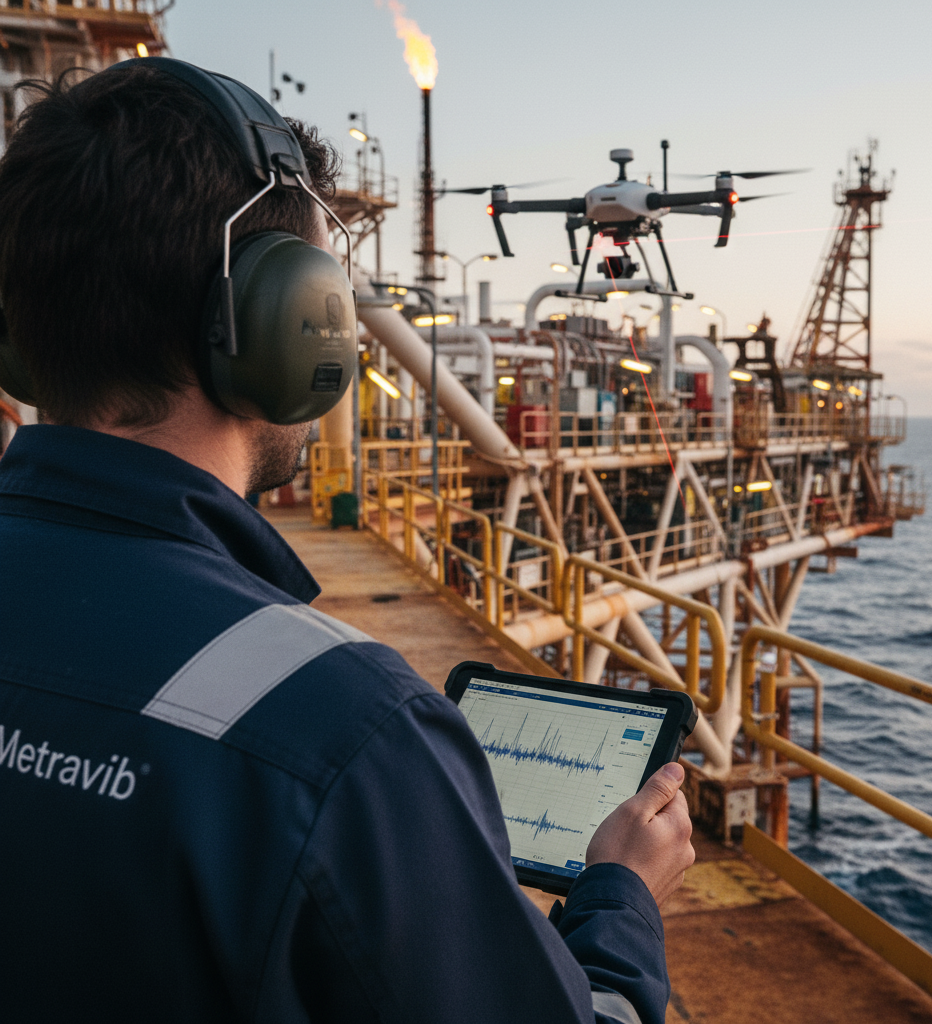
AI-powered intelligent onboard acoustic detection

On-board acoustic detection: towards tailor-made solutions based on AI

At Metravib Engineering, we draw on our long-standing expertise in acoustic signal analysis to meet today’s industrial surveillance challenges. From end-of-line inspection to gas leak detection, our know-how has gradually grown to include intelligent on-board systems, capable of identifying operating anomalies in real time.

From field experience to embedded intelligence

In the energy, defense, and aerospace sectors, absolute performance is no longer negotiable. Faced with assets deployed in hostile or confined environments, traditional maintenance strategies (reactive or calendar-based) are showing their limitations: they are costly and unpredictable.

Metravib Engineering is orchestrating this shift towards predictive and autonomous maintenance. By converting vibrations and acoustics into decision-making intelligence, we transform ambient sound into a lever for reliability. Our Acoustic Intelligent Detection (AID) technology, coupled with AI, makes it possible to anticipate failures and automate monitoring where human intervention is prohibited.

A modular and customizable approach

Rather than offering an off-the-shelf solution, we start from the specific needs of each environment to build a tailor-made architecture, while capitalizing on our existing technological building blocks. This hybrid approach allows us to:

  • Reduce development times and costs.
  • Adapt interfaces and integration conditions.
  • Maximize the relevance of acoustic processing according to the context.

Our AID technology is available in three monitoring levels with scaling capabilities:

   1. AMIS (Acoustic Monitoring of Industrial Sounds)

  • Typical Use Case: Monitoring acoustic pressure levels on an industrial site and identifying the source’s origin.
  • Technical Complexity Level: Low.

   2. AGLED (Acoustic Gas Leak Early Detection)

  • Typical Use Case: Smart gas leak detection on industrial sites with 3D source localization via a sensor network.
  • Technical Complexity Level: Medium.

More information about AGLED

   3. AMAD (Acoustic Monitoring for Anomaly Detection)

  • Typical Use Case: Acoustic monitoring of industrial machinery to prevent anomalies, including spatial filtering for targeted listening.
  • Technical Complexity Level: High.

More information about AMAD

AI Paradigms: From Conventional Thresholds to Unsupervised Learning

The power of the AID platform lies in its ability to integrate different artificial intelligence paradigms, tailored to the complexity of the problem at hand:

  • Conventional Detection: A robust baseline method based on sound level threshold detection. It forms the foundation of acoustic monitoring.
  • Supervised AI: This approach uses an artificial intelligence trained on labeled data (e.g., gas leak recordings) to perform specific classification and detection tasks with high accuracy.
  • Unsupervised AI: Representing the frontier of innovation, this paradigm detects unknown anomalies without any prior fault data. The AI learns the “sound signature” of normal operation (incorporating all phases of process or environmental variation) and identifies any deviation from this baseline.

Building a partnership together

We’re looking for pioneering industrial partners who wish to explore the potential of intelligent acoustic detection within their own context.
If you believe certain acoustic signals in your facilities should be intelligently interpreted, let’s discuss it. Our goal is not to offer a standardized solution, but to co-develop the one that precisely meets your needs with you.

Let's work together to develop the solution that's right for you.
Contact us